


T he main objective of the ZVČ SR is to search, process, analyze, and share relevant aspects within scientific, technical, educational and economic areas. The mission of the association is to help solve problems in these areas, support the work of all its members and coordinate approaches to problem solving.
NEWS
Energy efficient solutions for sludge pumps and problems associated with inefficient technical designs
Introduction
It is common knowledge that pumps are the second most widely used machine in the world after electric motors. According to other statistics, it turns out that for manufacturing companies (which also include water companies), up to 20-25% of capital expenditure of components (KAPEX) consists of investments in pumping aggregates. As a third statistic, up to 4% of the electricity consumed worldwide is spent by water utilities. Although the extreme fluctuations in electricity prices from 2022 stabilised in 2023, electricity prices have stabilised at incomparably higher levels than in previous years and the trend does not assume a decline, quite the opposite. This information shows that pumps have been, are and will continue to be one of the main topics in reducing operating and investment costs in water utilities. This is especially the case with wastewater pumps, which are highly strenuous and subject to many times higher wear and tear compared to drinking water pumps.
How to achieve the most efficient operation of sludge pumps
The most used phrase in water companies on the topic of sludge pumps is undoubtedly: "with sludge pumps, it is not worth looking at efficiency, but so that they do not clog..."
I believe that it will be demonstrated in the next part of the text that the non-clogging of sludge pumps is a fundamental requirement in practice, but not the only one.
The most effective compromise tool used to achieve efficient operation is the use of the "machine lifecycle" tool. The justification for this type of analysis is starting to gain momentum these days. This is mainly due to the fact that nowadays almost every manufacturer offers a type of hydraulics that can cope with the specifics of today's wastewater (e.g. helical impeller, non-clog o.k., channel o.k., adaptive o.k., etc...). More specifically, for example, with wet wipes, etc. Therefore, today is the time when looking only at clogging leads to limited results in terms of savings.
Life Cycle Analysis – LCC
A key objective of analyzing overall LCCs is to minimize total costs, which involves trade-offs between elements of the LCC analysis. This analysis is a strategic tool for determining whether initial costs are worth it after considering large future costs such as maintenance, energy, and downtime.
It can be used not only in the purchasing department. It is an important tool to help plant managers choose between alternative sources and decide between a repair and a new purchase.
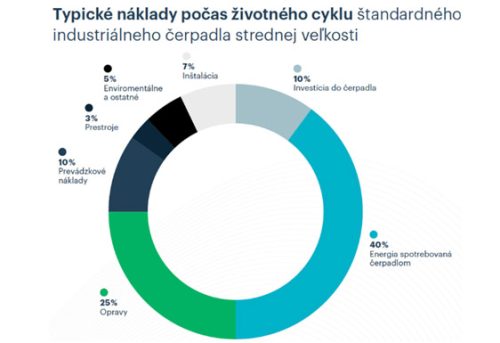
Compared to sludge pumps with, for example, drinking water pumps, it is much more important for sludge pumps to look at the issue of life cycle analysis much more comprehensively. This is precisely due to clogging of the pumps and increased wear due to the pumped medium. In addition to the basic view of typical life cycle costs, it is necessary, for example, to supplement the operator's experience with specific types of hydraulics in specific positions, take into account the service life of machines or the provided pump warranty, etc... This view is also applied in Slovakia, where water companies create pump committees, change competition criteria, etc...
Example of an inefficiently operated SPS sewer pumping station from practice:
The example points to one real pumping station within 25 years. Where during this period the replacement of machines occurred 3 times.
Table 1
| 1. | 2.1 | 2.2 | 3. | |
|---|---|---|---|---|
| Originally installed pumps since 1995 | Specification of parameters - purchase of pumps 2022 | Real pump operating operating point 2022 | Real-world pump specification 2022 | |
| Legacy pumps | Current pumps | Current pumps | Newly designed pumps | |
| Q (l/s) | 100 l/s (88- 123 l/s) | 68 | 108 | 100 |
| H (m) | 4,1 m (0,3 – 0,4 bar) | 7 | 4,1 | 4,1 |
| Ƞh (%) | 68,00% | 73,10% | 61% | 80,7% |
| Ƞel.mot (%) | 85 | 86 | 87 | 87 |
| Pmot (kW) | 9,4 | 9 | 9 | 9 |
| Speed (ot/min) | 980 | 980 | 980 | 980 |
Table 2
| Electricity price | 150,00 € | MWh | ||||||
|---|---|---|---|---|---|---|---|---|
| Pump - work. | Pump | Q (l/s) | H (m) | Pcelk (kW) | kWh/m3 | Power consumption per 1r | Electricity consumption in EUR | |
| 1 | Originally installed pumps since 1995 | 100,00 | 4,10 | 6,96 | 0,019 | 60957,78 | 9143,66 | |
| 2.1 | Specification of parameters - purchase of pumps 2022 | 68,00 | 7,00 | 7,43 | 0,030 | 95687,53 | 14353,12 | |
| 2.2 | Real pump operating operating point 2022 | 108,00 | 4,10 | 8,19 | 0,021 | 66390,80 | 9958,62 | |
| 3 | Real-world pump specification 2022 | 100,00 | 4,10 | 5,73 | 0,016 | 50183,87 | 7527,58 |
As can be seen from the above data, at the end of the pumps' life in 1995, the service station operator procured new pumps that were more efficient than the original ones (points 1 and 2.1). However, due to process error, where labelled parameters were read from the pump instead of operating parameters (point 2.1), pumps that are less efficient in operation than the original 1995 ones were procured. Up to more than 20% (point 2.2 and point 3).
Similar errors have been introduced in several projects to renew machines and equipment in order to reduce electricity consumption. As a result, savings were not demonstrated and these intentions were suspended. On the other hand, there are many examples in practice where it has been possible to eliminate both clogging of pumps and at the same time reduce electricity consumption by the right design and selection of specific hydraulics:
Conclusion
The issue of sludge pumps has been discussed for many years in order to find the most effective solutions, or to merge on the one hand the requirements for trouble-free operation, namely not clogging, on the other hand, to reduce electricity consumption. Today's time gives a prerequisite for a great shift in this direction, due to the development of new types of hydraulics.
Bibliography
- Maroš Hyriak, Presentation "Product life cycle analysis with cost calculation of different machine life cycle scenarios", slide 7, 2023
- Marek Miškov, Presentation "Case study Horný Hričov", 2023
- Life-cycle costs of industrial pumps, available at: https://www.pumpsandsystems.com/life-cycle-cost-analysis-industrial-pumps
- Maroš Hyriak, Article "Analysis of technical infrastructure as the first step for achieving energy efficiency of society", 2023
HISTORY OF PUMP PRODUCTION
Water is one of the most important elements for life, and therefore the availability of water played a key role in the development of civilization. The mechanical pump was invented as early as the 3rd century BC by the Greek inventor and engineer Kthesibius. The first pumps were driven by manual or natural forces – water mills powered by animals.
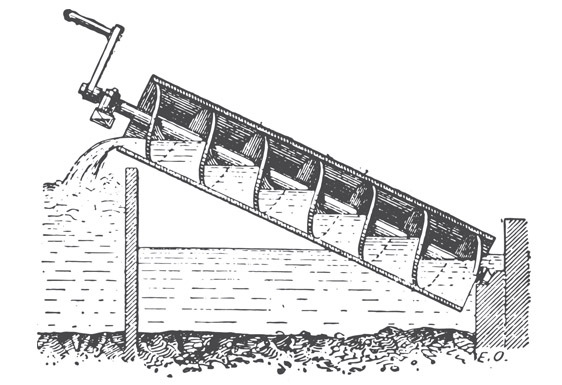
Archimedes' screw, the so-called infinity screw, was described, but not invented, by the ancient Greek mathematician and engineer Archimedes (480–67 BC). It was a mechanical device used for pumping water and is still used for pumping wastewater and bulk materials. Archimedes' screw was a huge spiral enclosed in a wooden cylinder and, by means of rotation, moved the water upwards.
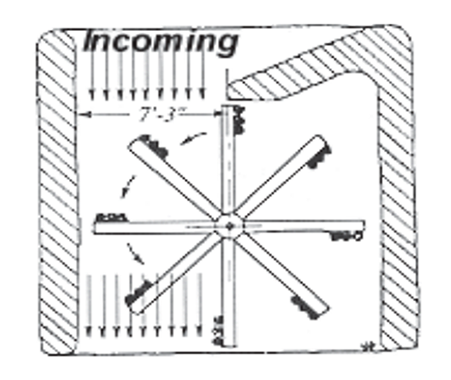
Pressure pumps were described by Philus Byzantius, Herus of Alexandria (magic fountain) and Vitruvius. The pressure pump is used in wells for pumping water, in sewer water boats, as a cellar pump, in mining equipment, in fire extinguishers and water jets. The first windmills were invented to automate grain milling and water pumping, later known as the vertical axis system developed in Persia (500-900 AD).
In 1580, a sliding vane pump was invented, and later a gear pump for this. The piston vacuum pump was invented in 1650 by a German scientist and politician out Guerick. The piston pump was invented in 1675 by the seventeenth-century English academic and mathematician Sir Samuel Morland.
At the end of the eighteenth century, a breakthrough occurred with the invention of the steam engine by James Watt. Rapid development in industry occurred in the 19th century in the production of heat and electric motors, which also provided a solution to several problems that would not have been possible without pumps. Today, all existing pumps open up a completely new horizon in the use of water resources.
MEMBERS
PRAKTIKPUMP, s.r.o.
Since its establishment, PRAKTIKPUMP has profiled itself as an engineering and implementation company for technological units, with an emphasis on mechanical technology. We are a comprehensive partner that covers projects from the initial technological design, through design, implementation, engineering, to final technical documentation and certification.
The company has a professional engineering and implementation base, thanks to which it covers demanding mechanical and technological realizations and complex turnkey projects. These often include not only the typical range of engineering and implementation activities, but also the field of research and development of equipment and the work as a whole.
The core of our activities is many years of expertise in the field of rotating machines. We are an expert in industrial applications of pumping and vacuum technology. We offer professional services in the field of pumps, blowers, vacuum pumps or fittings.
Our teams of experienced hydraulics and designers have been covering complex turnkey projects in the water and industrial sectors for many years. At the same time, we have the largest service center for spinning machines in Slovakia.
SPIRAM, s.r.o.
SPIRAM helical pumps are an original product of PRAKTIKPUMP, s.r.o. Their development and production takes place in Slovakia and are the definition of a modern pumping standard with low and medium pressure and high flow. The pumps are designed for pumping sludge with a high content of solid parts and meet the most demanding requirements of environmentally friendly operation.
SPIRAM pumps are centrifugal pumps with a single spiral-shaped impeller, which guarantees pumping of media with minimal probability of clogging and at the same time maximally reduces the possibility of winding fibrous substances at high efficiency. This fact significantly reduces the operating costs of the device. These benefits make SPIRAM pumps suitable for pumping hard-to-pump media with a high solid content.
 English
  Slovak